Why I'm betting ten years on weeds
I just spent six years building a fintech. I'm about to spend the next ten on the weeds our chemistry can no longer kill. Buva is only where it starts.

On July 1st, 2026, I started full-time on a problem most of the world doesn't know has a name.
Across every major crop region on the planet, the weeds are quietly winning. The herbicides that built modern agriculture are failing, one active ingredient at a time, as the plants they were meant to kill evolve resistance faster than the industry can invent replacements. This is not a Brazilian problem or an American one. It is an agriculture problem.
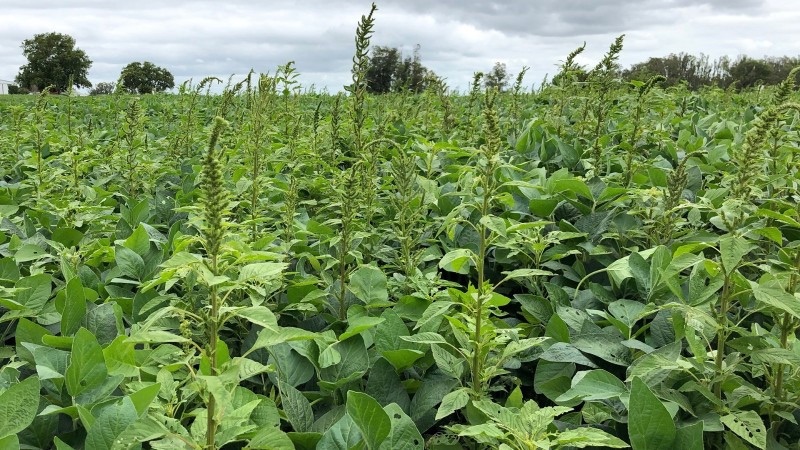
It just wears different faces. In the United States, one of the worst is pigweed: Palmer amaranth and waterhemp, the Amaranthus family that Brazilians call caruru. They shrug off glyphosate, ALS inhibitors, PPO inhibitors, and more, and they have become the single most expensive weed problem in American row crops. In Brazil, one of the most damaging is buva (Conyza spp.), resistant to glyphosate, to ALS inhibitors, to 2,4-D. A field that used to spend around R$120 per hectare on weed control now spends R$300 to R$450 wherever resistance has taken hold. Next season, likely more.
I just spent six years building and selling a fintech. I'm about to spend the next ten on this: not on one weed, but on the whole class of them our chemistry is losing to. I'm starting in Brazil, because it is where the pain is sharpest and where the first fields are a short drive from my door. The weed is local. The problem is global.
These are the weeds I'll be working against first. The same plants carry different names across the Americas:
- Buva · horseweed / fleabane · rama negra · Conyza spp.
- Capim-amargoso · sourgrass · pasto amargo · Digitaria insularis
- Caruru · pigweed / amaranth · yuyo colorado · Amaranthus spp.
- Pé-de-galinha · goosegrass · pata de gallina · Eleusine indica
- Trapoeraba · Benghal dayflower · canutillo · Commelina benghalensis
- Azevém · Italian ryegrass · raigrás · Lolium multiflorum
This post is my attempt to explain why: to myself, to the farmers I've been talking to, to the investors I'll be talking to, and to anyone who has ever driven past a field of soybean and assumed the technology inside it was somehow sufficient. It isn't.
Where I come from
I grew up on a farm in northeast Rio Grande do Sul, in the south of Brazil. Small property by soy belt standards. The kind of farm where you know every terrace, every fence post, every spot the tractor gets stuck when the soil is too wet. My family grew row crops, speciality crops and raised animals. I spent school mornings at a desk and most afternoons somewhere outside.
I left that world for software. I studied computer science, moved into banking, then co-founded a fintech in 2020 called 7AZ. We built Pix-native payment infrastructure for Brazilian internet providers, scaled it from zero to a meaningful business, and sold it to Bemobi (a publicly traded Brazilian company) in 2023. Two and a half years from the first line of code to the acquisition agreement. Six from the beginning to the end of the earnout, which closed on June 30.
Those six years taught me how to build a company. They also made it impossible to ignore the one I didn't build.
While I was wiring payment APIs into ERPs, my family and our neighbors were having a different argument every planting season. The herbicides weren't working like they used to. The chemical bills were climbing. The "solution" their retailers sold them was always the same: another molecule, another combination, another pass over the field. Each year more expensive. Each year a little less effective.
I kept that conversation in my head while I finished the fintech. When 7AZ closed the earn-out and I had the chance to choose what came next, the choice wasn't really a choice. It was a return.
What weeds actually cost
Several weeds in Brazilian row crops have developed resistance to the chemistry we rely on. The list includes sourgrass (Digitaria insularis), Italian ryegrass (Lolium multiflorum), and others. What they share is an economic signature that farmers read directly in their cost sheets.
The conventional math looks like this:
- A clean, low-resistance field spends roughly R$120 per hectare per cycle on herbicide and application. That's tank mix, fuel, labor, the full broadcast spraying job.
- A field with meaningful resistant pressure (resistant buva, resistant sourgrass, or both) spends R$300 to R$450 per hectare. Sometimes more. More passes, stronger mixes, shorter residual effect.
The gap is not a one-time tax. It is a growing line item. Every season, more hectares cross from the first category into the second. Embrapa's own reports document the expansion. So do the cost surveys from CONAB and the state agricultural federations.
And here is the part that is easy to miss: this is happening while the pipeline of new herbicide molecules is drying up. Very few genuinely new modes of action have been registered in the last two decades. The companies that sell crop chemicals are consolidating, not inventing. China's phytosanitary suspensions in 2025 made every Brazilian farmer rediscover exactly how dependent their cost structure is on a small number of active ingredients made far away.
So the problem isn't only that resistant weeds are expensive. It's that the only tool we have for them is itself becoming expensive, scarcer and less effective at the same time.
This is not a problem you solve with another molecule.
What the field taught me
I have not spent the last year running a formal survey. I was still finishing the earnout at 7AZ. What I did instead was study, the way you study a problem you already feel in your gut: the agronomy manuals, the Embrapa resistance tables, the cost sheets, the machines that exist and the ones that stubbornly don't. And I paid attention, the way you pay attention to a world you grew up in, to my family, to their neighbors, to the producers I have known my whole life.
Three things kept surfacing.
First, they know the problem is getting worse. Every producer I spoke to could name, without hesitation, the weeds giving them trouble. They could estimate, with surprising accuracy, the cost delta between their cleaner fields and their worst ones. None of them were in denial. They were in negotiation. With their chemical retailers, with their agronomists, with their own budgets.
Second, they are exhausted by "solutions" that are actually recommendations. Many of them have used apps, drones, scouting services, and satellite imagery. Most of them shrug when you bring these up. The value proposition of a recommendation tool is: pay us to tell you what your problem looks like. But the producer already knows what their problem looks like. They need someone to do something about it.
Third, and this is the one I didn't expect: none of them asked for a robot. Not once. When I described what I was thinking of building, the response was never "yes, that's exactly what we need." It was always, in some form: "If it works at a price I can pay, I'll try it. Show me." They weren't buying a category. They were skeptically open to a specific economic offer, evaluated against the cost of chemistry they already pay.
That distinction matters. It told me two things. One: the demand is real but it is not romantic. Nobody will buy autonomy for autonomy's sake. Two: the only way to win this market is to show up with a machine that works in the field, on their soil, at a price they can compare line by line to their herbicide budget.
Everything else is noise.
Why mechanical, why now, why me
With that as the ground, the shape of the product follows almost mechanically.
Why mechanical removal instead of precision spraying. Precision spraying (the John Deere See & Spray or Solinftec Solix model) is interesting. It reduces herbicide volume by spraying only where weeds are. But it still depends on the same chemistry the market is losing. If the problem is that the herbicide itself is failing, reducing the dose doesn't fix the underlying equation. You need to remove the weed without the molecule. It simply is not a long term solution.
Why not a vegetable-crop robot. Carbon Robotics and FarmWise have built impressive machines for specialty crops in the United States. But a lettuce field and a soy field are not the same problem. Different row geometry, different economics, different scale, different country. The robot that weeds a Brazilian soy row cannot be a vegetable robot carrying a Brazilian flag.
Why autonomous, why diesel-electric, why now. A weeding robot that needs an operator in the cab costs roughly what a regular tractor costs, plus a robot premium, and gains nothing in margin for the farmer. Autonomy is not a feature: it is what makes the economics work. Diesel-electric, because a full working day in 40°C Mato Grosso heat is non-negotiable and battery-only drivetrains don't yet close that gap for a machine this size. Now, because every additional season that passes is another 5 to 15% of hectares crossing into the "resistant" column of the spreadsheet.
Why me. I don't have an agronomy degree. What I have is:
- A farm upbringing that makes the conversations with producers feel like going home, not like fieldwork
- The technical ability to lead the machine's design and build the first prototypes hands-on
- A completed startup cycle, which means I know what the full arc of a company demands from its founder
- The willingness to live in Tunápolis while I build, instead of outsourcing the problem to a São Paulo office
Aurox is a hard company to start. It is a less hard company to start for someone with that specific combination. I don't claim this makes me the best person. It does make me a credible person. And the right kind of company is built by whoever actually shows up.
And I'm not showing up alone. By the time I'm writing this, Aurox is already a team. A mechanical engineer relocated to Tunápolis to design and build the machine alongside me. A head of agronomy who spent a decade inside one of the largest cooperatives in southern Brazil brings the field and the channel from the inside. A head of manufacturing with almost thirty years maintaining agricultural machines brings the kind of hands that know why a design will fail before it fails. My job is to point that team at the right problem and keep us moving. "Why me" is really "why us."
What we are building
The first machine is called ARX-1. It will be a four-wheel-drive rover with independent steering on all four wheels and a diesel-electric drivetrain, carrying a front-mounted hoe array that spans ten crop rows, roughly 4.5 meters wide. It will be autonomous. Before it enters a field, a drone flies the area and turns the imagery into a map of the crop rows, the lanes between them, and the obstacles to route around. In the field, the robot fuses that map with RTK-GPS for global position and onboard cameras that read the rows in real time, keeping the hoes in the lane within a few centimeters. A person supervises remotely and steps in only by exception. The machine drives itself. It will detect weeds with a computer vision model trained on images we collect this coming season. It will remove them mechanically: an array of selective hoes, each dropping only on a confirmed weed and leaving the crop untouched.
No chemistry in the first product. No broadcast action. No general-purpose platform ambition at launch. One job, done well, at a price that competes directly with the herbicide bill the farmer already pays.
The commercial model is a per-hectare service. Aurox owns the fleet. The farmer doesn't buy the robot, they buy weeded hectares. This matters because hardware sales tie the machine's fate to a single season's capital cycle on a single farm. Service pricing ties the machine to repeatable utilization across many farms, and lets us iterate the hardware without orphaning customers.
The first commercial offer inside this model is targeted at producers with resistant weed pressure in the central-south soy belt. It is not the last thing the company will do. It is the wedge.
Numbers I can share, with the honesty that all of them are hypotheses until the field validates them:
- Target price: around R$250 per hectare treated
- One robot, covering both soy and safrinha corn windows, utilization goal around 2,100 hectares per year
- Robot build cost estimate: around R$150K
- Annual operating cost per robot: around R$45K
These numbers are what I'm going to spend the next twelve months trying to either confirm or break. I will post the results, confirmed or broken, here on this blog as they happen. That is the only honest way to build.
The ten-year bet
Why ten years? Because 7AZ, the fintech, took six, and that was software. This is hardware working in a field, and hardware in a field does not move faster than software. It moves slower: heavier, more stubborn, less forgiving of shortcuts.
Nothing meaningful in hard tech happens in twelve months. You can build a prototype in eighteen. You cannot put it in a field, fix everything it gets wrong, iterate the mechanism, train the detection model, build the operations team, sign the first cooperatives and become the default weeding option for Brazilian soy in a year or two. That work wants a decade. Committing to ten is just an honest version of realistic.
Here is what I'm actually committing to, publicly:
- Q3 2026 · subsystems built and bench-tested; ARX-1 core design locked
- Q4 2026 · integrated prototype and initial field tests on real farms
- 2027 · first commercial operation (safra 27/28), first paid hectares on real farms
- 2028 · commercial scale-up, first full safra with a fleet on contract
- 2029 to 2031 · scale, second product lines, platform expansion beyond weeding
Most of these dates will shift. Some by quarters, some by more. What will not shift is the direction and the pace. I've done this once, and the lesson from 7AZ is that the companies that survive aren't the ones that move fastest, they are the ones that don't stop.
If you are a farmer reading this, the invitation is simple: talk to me. Tell me what your weed cost looks like this year. Tell me what would need to be true for you to try something new. Email is lucas@aurox.ag.
If you are an investor, a researcher or a future teammate, same invitation, same email. The early years of a hard company can be lonely. Ours already aren't.
We'll be writing here every other week for the foreseeable future. Some of it will be technical. Some of it will be economics. Some of it will be about things that went wrong and what we learned. All of it will try to earn the opening sentence of this post: that it is worth betting ten years on a problem most of the world doesn't know has a name.
Because if we're right about weeding, we're right about a lot more.
← Todos os posts